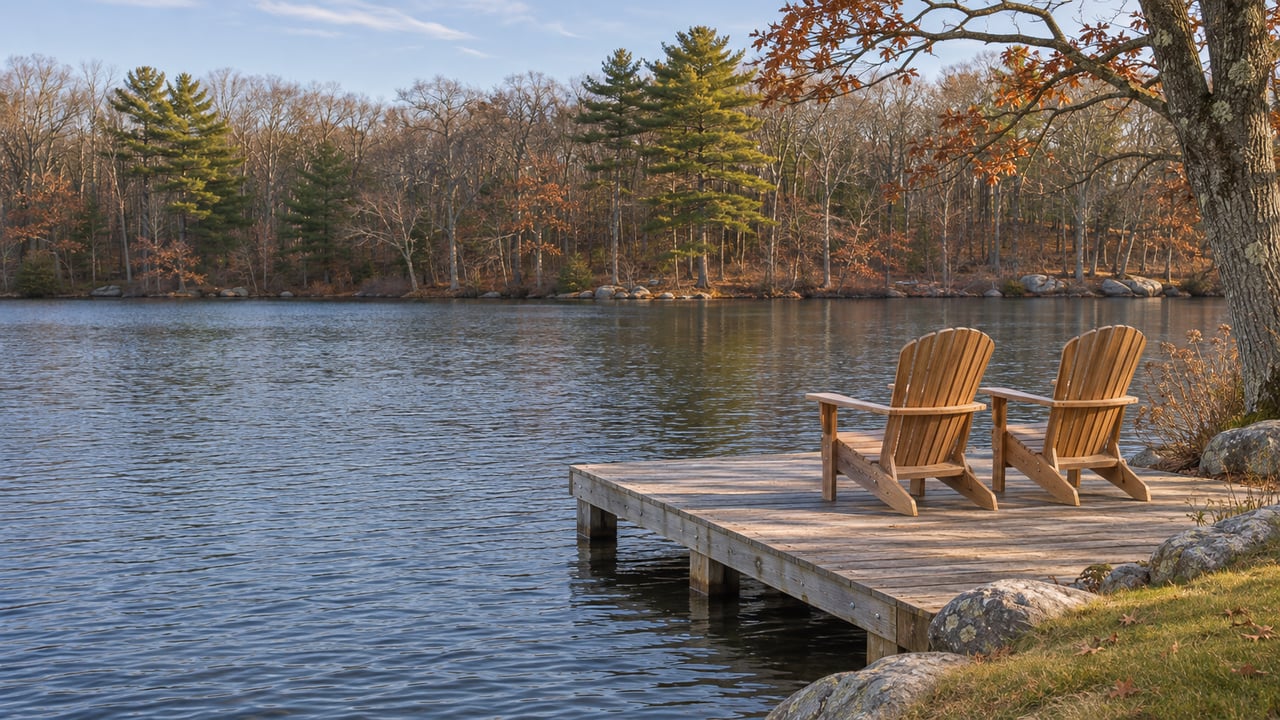
"To our year-round residents, thank you for being the steady heartbeat of this community all winter long." That line opens the Property Owners' Association of Lake Hayward's 2026 Spring Packet. It was written in spring, with the docks going back in, to thank the owners who keep the community going through the off-season. That same packet scheduled this fall's boat removal from the Lake Hayward racks for around the weekend of November 15 and called on volunteers to clear any boats still there. Elsewhere in town, the Connecticut Department of Energy and Environmental Protection has posted a three-foot drawdown of Bashan Lake. It was set to begin on or about November 1, 2026, with the water back to normal by early April 2027.
Late fall is a good time to compare East Haddam's lakes, because that's when the work of keeping them up is easiest to see. All three lakes have a state boat launch. All three are fighting invasive weeds. What sets them apart for a buyer is who pays for that work and how. Lake Hayward runs it through a taxing district with its own tax bills. At Bashan Lake it's an association of neighbors. At Moodus Reservoir it's a volunteer nonprofit with a weed harvester. When you pick a lake, you're also picking one of those setups.
The water is the asset
The East Haddam Lakes Association made the financial case in its budget request to the town for fiscal year 2025-26. It says the communities around Bashan Lake, Lake Hayward and Moodus Reservoir make up nearly 20% of the town's real estate grand list. It also says higher valuation factors on those properties bring in about $1,200,000 in additional property tax. The same document cites a 1999 UConn and state study, "How Much is a Lake Worth To You." That study estimated that lake property values fall 36 to 43% if water quality drops to the point where swimming or eating the fish is unsafe.
The associations list the threats as invasive aquatic plants, algae blooms, stormwater runoff and erosion, failing septic systems, and lawn and household chemicals. They also name development that is out of character with each lake. The work against those threats includes herbicide treatments, mechanical weed removal, water testing and bacteria monitoring. Most of it is paid for privately by the lake communities, which is why they asked the town for help. For a buyer, that means the main thing behind a lake home's value is looked after by whoever lives on that lake. The three lakes split that job up in very different ways.
Lake Hayward looks after itself as a district
Lake Hayward covers 174 acres, which makes it the smallest of the three. Its governing body, POALH, says on its own site that it is "a special taxing district in East Haddam" and "not a Homeowners' Association." Board meetings are recorded and posted to a YouTube channel, and the site says no handwritten minutes are created.
The district's recent records show what owning the shared parts of a lake involves. Lake Hayward has three association beaches, and the association has been testing them weekly for E. coli. Lake water is tested twice a month in season, with samples analyzed by professionals and the in-water work done by resident volunteers. It has also been treating fanwort, which grew especially thick near the state launch, and sampling the streams that feed the lake to track down the nutrients behind its occasional algae.
The dam is the biggest item. According to POALH's explainer on the dam funding referendum, a 2019 dam safety report found deficiencies. The association applied for a repair permit in February 2024, and the permit was signed on October 5, 2025. DEEP's August 2025 notice on the permit lists the work. It includes replacing the spillway walls, building a new concrete embankment, repairing the spillway apron, and adding a passage for eels. Members voted by mailed ballot. The votes were counted on May 1, 2026, and a majority approved the project, along with $50,000 from capital reserves to lower the special assessment.
According to the spring packet, the dam special assessment was billed effective September 1, 2026. The repair was decided and paid for by the people who own around the lake, through their own district and their own vote.
Lake Hayward also has the busiest summer calendar of the three. The 2026 packet called summer "cottage season." It listed pickleball on Tuesday and Thursday evenings, a Thursday happy hour at the Pavilion, trivia and karaoke on Fridays, and bands and food trucks on Saturdays when available. This spring, volunteers rebuilt the boat racks at Second Beach, and a new playground and swing set opened.
Bashan Lake runs on an association that speaks up
Bashan Lake covers 273 acres. The Bashan Lake Association is the main caretaker there, and its recent work has been about protecting the lake from outside threats. In 2024, the Connecticut Agricultural Experiment Station found hydrilla in the lake, and 50 plants were pulled by hand in the dam cove. Milfoil came back and spread through the boat-launch cove, too widely to pull by hand. DEEP's launch page now warns of a risk of cyanobacteria blooms. To keep more invasives out, the association won a two-year DEEP grant to pay for boat inspectors at the state launch on weekends from May through October.
The association also speaks up about how the lake is used. It has worked with the Seaplane Association and Goodspeed Airport to stop seaplane landings and takeoffs on Bashan Lake. It polled residents on a proposed cell tower that would be visible from the lake, and 61% opposed it. Its 2025-26 goals include asking the town for an ordinance banning wake-surf boats on Bashan. The goals also include working with the town to stop small-lot seasonal cottages from being converted into year-round homes without the town's knowledge. Owners on Bashan get an association that takes positions on what happens around the water as well as on it.
Moodus Reservoir is the big lake, kept up by volunteers
Moodus Reservoir is the largest of the three at 486 acres. It has an upper and a lower basin, each with its own state launch. The Moodus Reservoir Preservation Group reports that a town vote on a wake-surfing amendment for the reservoir passed 202 to 49. East Haddam's recreation page describes Moodus Reservoir as the site of the town's only public beach.
The group describes itself as a nonprofit whose members are shoreline owners, lake users and community associations. Its main tool is an Ecoharvester run by volunteers, and a boating license is needed to operate it. The group has held free state Safe Boating courses partly to train more operators. Minutes from its August 12, 2025 meeting say the harvester had removed 63 loads of weeds by then, 47 from the lower reservoir and 16 from the upper. The group had proposed stocking sterile grass carp in the upper reservoir as a test. DEEP decided it could not permit them. Last winter's two-foot drawdown, approved for November 1, 2025 through March 1, 2026, was set up through the group working with the town and DEEP.
The money comes from neighbors. The group's June picnic sold 130 tickets and raised about $3,000, and its March spaghetti dinner has typically sold about 90 tickets. The group's weed control depends on how many owners volunteer on the harvester, buy tickets and come to meetings. The group reports that turnout at its monthly meetings has risen considerably.
What this means for a winter purchase
Taken together, the three lakes run from the most formal setup to the least. Lake Hayward's costs arrive as district bills, and this year that included a special assessment for the dam. Bashan Lake's costs are partly grant-funded and come with an association that takes positions on cell towers and seaplanes. Moodus Reservoir's costs are paid in volunteer hours and dinner tickets. That gives the most room to someone willing to pitch in, and it relies on people doing so.
The regional market gives buyers time to sort through this before spring. In the Eastern Connecticut REALTORS October 2026 report, the region's median single-family price was $410,000, down 2.4% from October 2025. Single-family sales fell 17.3% to 258 for the month, and inventory rose 15.4% to 681 homes. Those are regional numbers, not East Haddam or lakefront figures. Still, more homes and fewer sales leave a winter buyer room to learn who looks after the water at each lake, what that group has spent its recent years on, and what has been growing near a home's dock.
Taxes are also changing. East Haddam's assessor lists the town's last revaluation as 2022 and the next as 2027. The lake communities already carry a large share of the grand list, so the 2027 numbers matter to anyone who buys on the water before then. Our East Haddam neighborhood page and our earlier piece on life along the Connecticut River in East Haddam cover the rest of town, from Goodspeed Landing to the village.
A few quick answers
Which lake is the largest? Moodus Reservoir, at 486 acres, followed by Bashan Lake at 273 and Lake Hayward at 174.
Is the water level lower in winter? It can be. DEEP posted a three-foot Bashan Lake drawdown starting on or about November 1, 2026, with normal levels restored by early April 2027. Moodus Reservoir had a two-foot drawdown last winter. For a buyer, a winter showing can be a good time to look at the shoreline and the dock footings.
Can anyone launch a boat? Each of the three lakes has a Connecticut state boat launch.
If one of East Haddam's three lakes is on your list, a winter conversation is a good place to start, while the water is down and the docks are out. Reach out to Tammy Tinnerello to talk through the lake communities and the homes around them. Work With Tammy.